
Can You Fake Your Way Into AI Answers?
topgeo.ai Team
Author
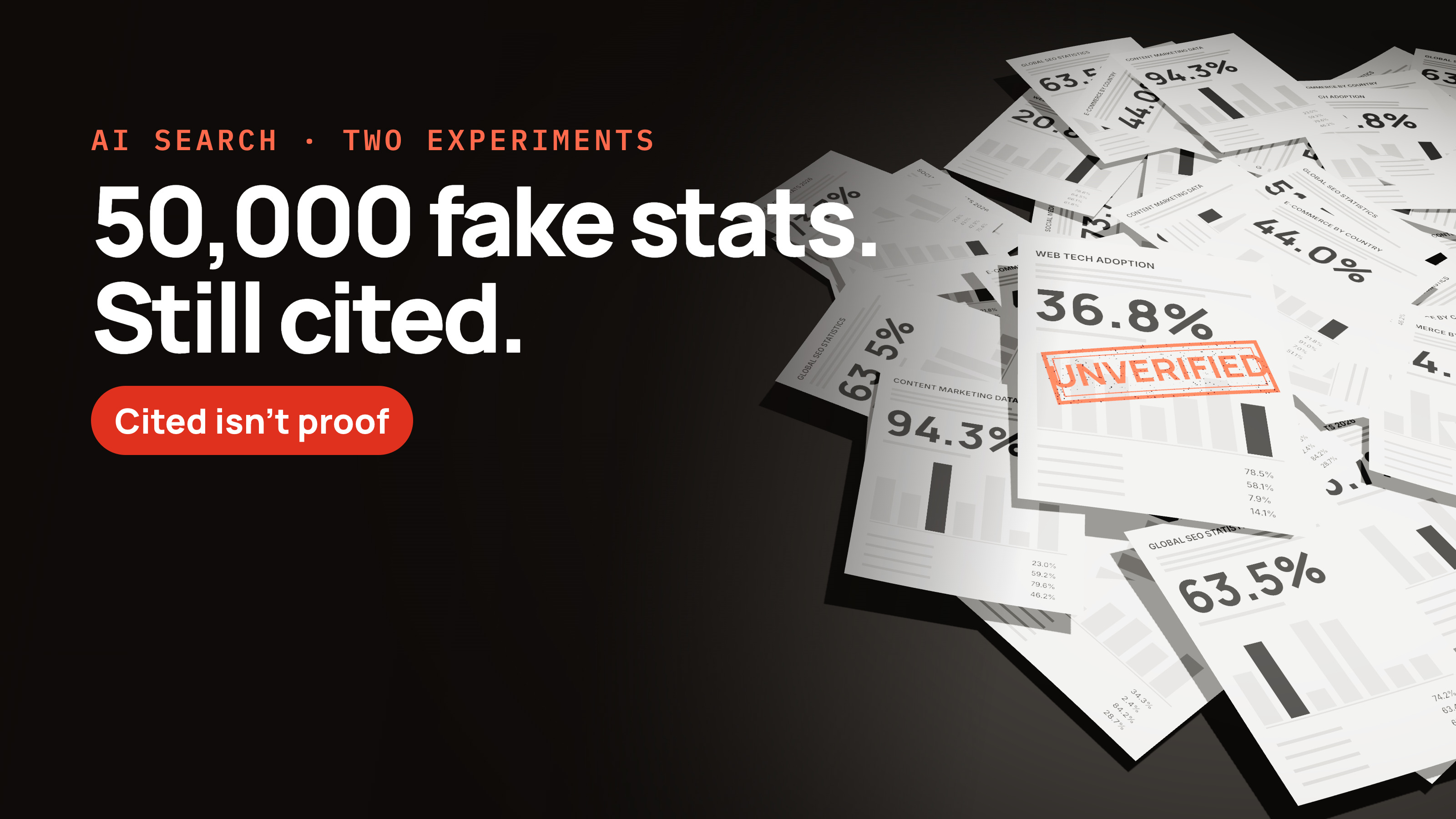
For a while, yes, and that's the problem. Two new experiments show how easily invented content can end up in AI answers. One researcher published 50,000 made-up statistics for about $50 and says ChatGPT kept citing them for months. In a university study, 8 of 10 AI search tools cited a made-up concept within a week. Being cited by AI is not the same as being right.
This is the gap topgeo.ai works on. topgeo.ai publishes AI-optimized answer pages on your own domain, and scores every page on grounding, SEO, citability and conversion before it goes live. You can see where you stand with a free AI visibility snapshot.
What did the $50 experiment do?
Metehan Yesilyurt, a GEO researcher at Peec AI, built a new site called StateGlobe with 50,000 pages of statistics on marketing and web topics across 200 countries. He says every number was invented: generated in one day with GPT-4.1 for about $30, plus 15,000 listicles for about $20. In his words, "I never checked a single one."
Here's what he reports:
- Google moved on: the site was indexed within a week, then its visibility collapsed after two Google updates.
- ChatGPT didn't: GA4 shows more than 10,000 sessions from ChatGPT since March.
- Live fetching: in the last 30 days, about 72,000 requests came from ChatGPT-User, the agent ChatGPT uses to fetch pages while answering.
- High visibility: on October 7, the site ranked second on his tracked prompts, behind only Statista, in Peec AI's own visibility dashboard.
- The numbers spread: he says the fake figures turned up in an academic paper and in investment research.
These are his own measurements, and they haven't been independently verified. He presents it as research, not a playbook: "The fake data certainly didn't become true, but every citation made it look more trustworthy." The site now carries a disclaimer.
What did the university study find?
The paper, "From Public Posts to AI-Search Citations: Measuring the Fragility of AI Search", was posted on arXiv on October 8, 2026 by Qi Liu and five co-authors at Fudan University. It's a preprint. The team tested 10 AI search platforms, including ChatGPT, Perplexity, Grok and Google's AI search, in March and April 2026.
- Fast pickup: 8 of 10 platforms cited a made-up concept within seven days of ordinary posts.
- Placement beat volume: one article on a platform the AI tools already favored had more impact than more than 20 matched posts on less-favored platforms.
- Cheap and quick: a $14 package from a commercial GEO posting service produced 13 posts, and one platform cited them within an hour.
The authors note the limits: the topics were fictional, not real brands or products, and the tests ran before Google clarified in May that its spam policies cover manipulating AI answers.
Should you try it?
No. Both teams frame their work as a warning, not a tactic. Made-up numbers don't become true when AI repeats them, and they can be traced back to you. The tools are also changing, so a gap that works today may close tomorrow.
What does this mean for your brand?
A citation tells you AI found your page, not that your page is right. That cuts both ways: weak sources about your category can end up in AI answers too. A few honest habits help:
- Publish real numbers, with sources: Yesilyurt's own advice for statistics pages is to cite sources with years and show when the page was updated.
- Be where AI already looks: in the Fudan tests, where content was posted mattered more than how much was posted.
- Keep pages fetchable: ChatGPT fetched pages live, so check that your site doesn't block AI retrieval bots.
- Check the sources behind AI answers: look at what AI says about your category and which pages it cites.
Sources: Metehan Yesilyurt, "Publish stats, get cited: The tactic that put my data all over the web", Peec AI, October 2026; Qi Liu et al., "From Public Posts to AI-Search Citations: Measuring the Fragility of AI Search", arXiv preprint, October 8, 2026; Search Engine Journal, "AI Search Tools Cited A Made-Up Concept Within A Week, Paper Finds", October 19, 2026.
Want to see what AI says about your brand?
Get a free AI visibility snapshot and see how your company shows up when buyers ask AI for a shortlist.