Do AI Engines Cite Your Site or Everyone Else's? Two Studies, Two Different Counts
topgeo.ai Team
Author
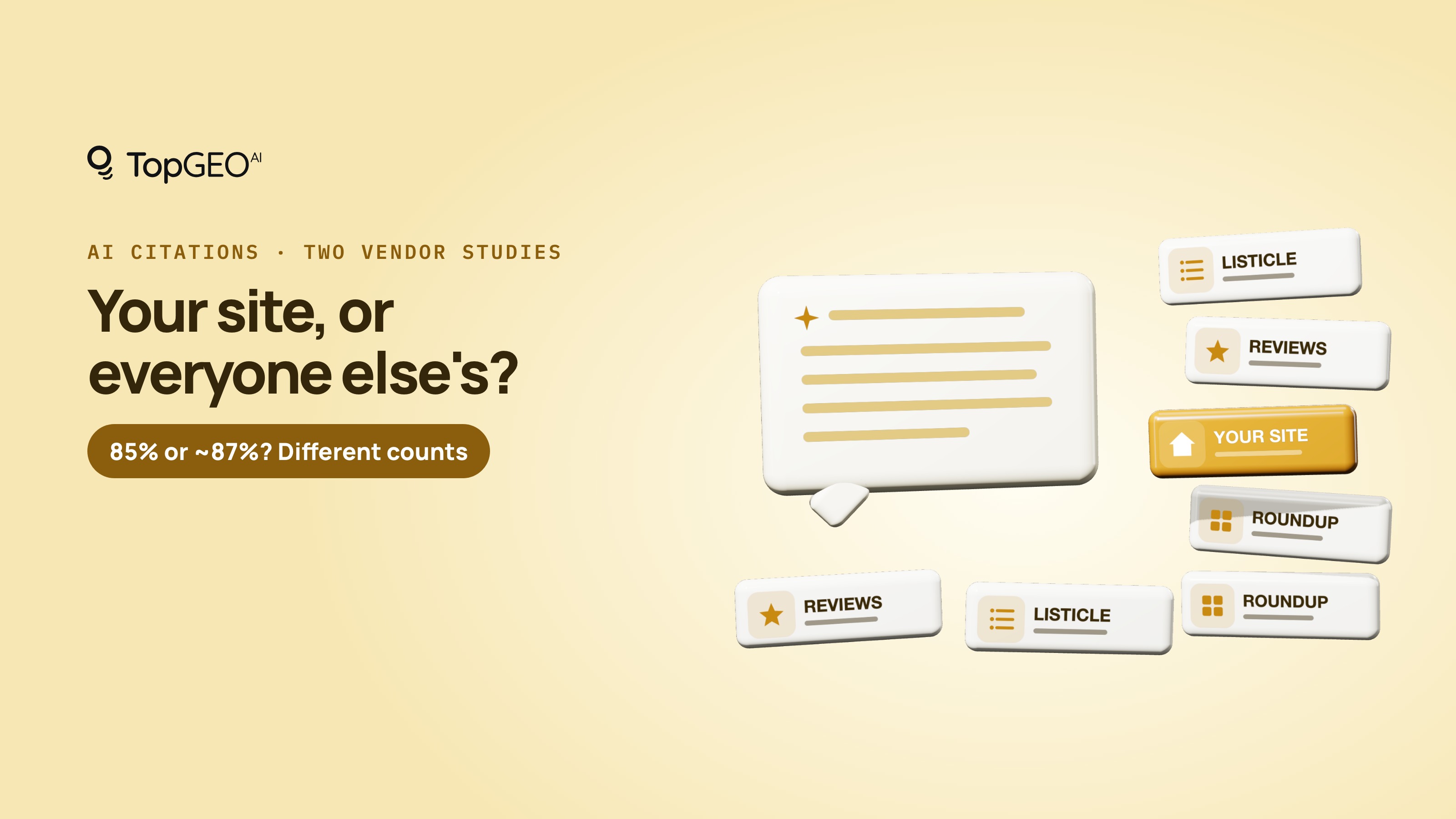
Mostly everyone else's, if you count individual citations, but that isn't the whole picture. A study published on November 4 by WhatsMyGeoScore found that 85% of brand citations in ChatGPT, Claude and Perplexity answers came from third-party pages such as listicles, review sites and roundups, and only 15% from the brand's own site. Dageno data reported by Tech Times on October 30 measures something else: about 87% of the ChatGPT answers it monitored included at least one brand-owned website source. Both numbers can be true at the same time, because one counts citations and the other counts answers. Neither vendor has published enough method to treat its figure as a rule for your brand.
What topgeo.ai does. topgeo.ai scans the primary AI engines to find out whether your brand is being recommended, and who is being recommended instead. We publish AI-optimized pages on your own domain, and citation and authority building is done for you. To see where you stand today, get a free AI visibility snapshot: two of your buyer questions, asked word-for-word on ChatGPT and Google AI Overview, with your AI-visibility score, who AI names instead and how many sources each engine used.
What does the 85% study say?
WhatsMyGeoScore, which sells a GEO scoring product called ORION, says it analysed 2,847 brand mentions in AI answers from ChatGPT, Claude and Perplexity between September and November 2026, covering 412 B2B SaaS brands. The queries were commercial: product comparisons, solution recommendations and tool searches.
Its split of where the citations came from:
- Comparison listicles: 34%
- Review platforms: 28%
- Industry roundups: 23%
- The brand's own site: 15%
The first three add up to the headline 85%. The post doesn't say how many queries were asked, how many times each was run, or how a page was sorted into each group. It also uses "mentions" and "citations" for the same count, so it isn't clear whether a brand named with no link was included.
What does the ~87% figure say?
It comes from a Tech Times article of October 30 about Dageno's Reddit research. In a short August window, comparing the six days before August 14 with the seven days after, the share of monitored ChatGPT answers with a Reddit link fell from 12.8% to 2.3%. Over the same days, the share of answers containing a brand-owned website source moved from 86.5% to 87.5%.
Tech Times adds its own caution: these observations "do not establish that company websites are inherently preferred by AI systems." When we checked on November 2, we couldn't find the study on Dageno's own website, so this number is second-hand.
Why don't the two numbers clash?
Because they answer different questions.
- 85% is a share of citations. Out of all the sources counted, how many were third-party pages?
- ~87% is a share of answers. How many ChatGPT answers linked to at least one brand's website?
Take one answer that cites seven sources: one brand's product page and six review or listicle pages. In the first kind of count, that's one own-site citation out of seven. In the second, it's an answer that "contains a brand-owned source". Do that across hundreds of answers and you can get a high number in both studies at once.
There's a second gap. "Brand-owned" in the Dageno figure means any company's website, which could be a competitor's. And the samples differ: three engines in one, ChatGPT alone in the other, different months, and query sets neither vendor has published.
What does this mean for your brand?
Not that your own site doesn't matter, and not that third-party lists are all that count. It means the mix depends on the engine, the question and the category, and neither study tells you yours. A buyer asking "best [category] for mid-sized firms" may get an answer built mostly from roundups. A buyer asking about your pricing or integrations may get your own pages.
How can you check your own split?
You can get a rough answer in an afternoon:
- Pick 10 questions your buyers really ask, word-for-word, mixing "best [category]" questions with questions about specific features.
- Ask each one in two or three AI engines and copy every linked source.
- Sort each source into one of three groups: your site, a competitor's site, or a third-party page such as a review site, listicle or forum.
- Count two ways: the share of all sources that are your site, and the share of answers that link to your site at least once.
- Repeat on another day. AI answers change between runs, so one pass is a snapshot.
If most of your citations come from third-party pages, the lists and reviews in your category matter. If answers about your product don't link to your site at all, your own pages may not be answering the questions buyers ask.
Sources: WhatsMyGeoScore, "85% of AI Brand Mentions Come from Third Parties", Calvin Ng, November 4, 2026; Tech Times, "Is Reddit Still Worth It for AI Search Visibility?", Carl Williams, October 30, 2026 (Dageno data).
Who does AI name instead of you?
Get a free AI visibility snapshot: two of your buyer questions, asked word-for-word on ChatGPT and Google AI Overview, with your AI-visibility score, who AI names instead and how many sources each engine used.