
Do Small Brands Show Up Less in AI Answers?
topgeo.ai Team
Author
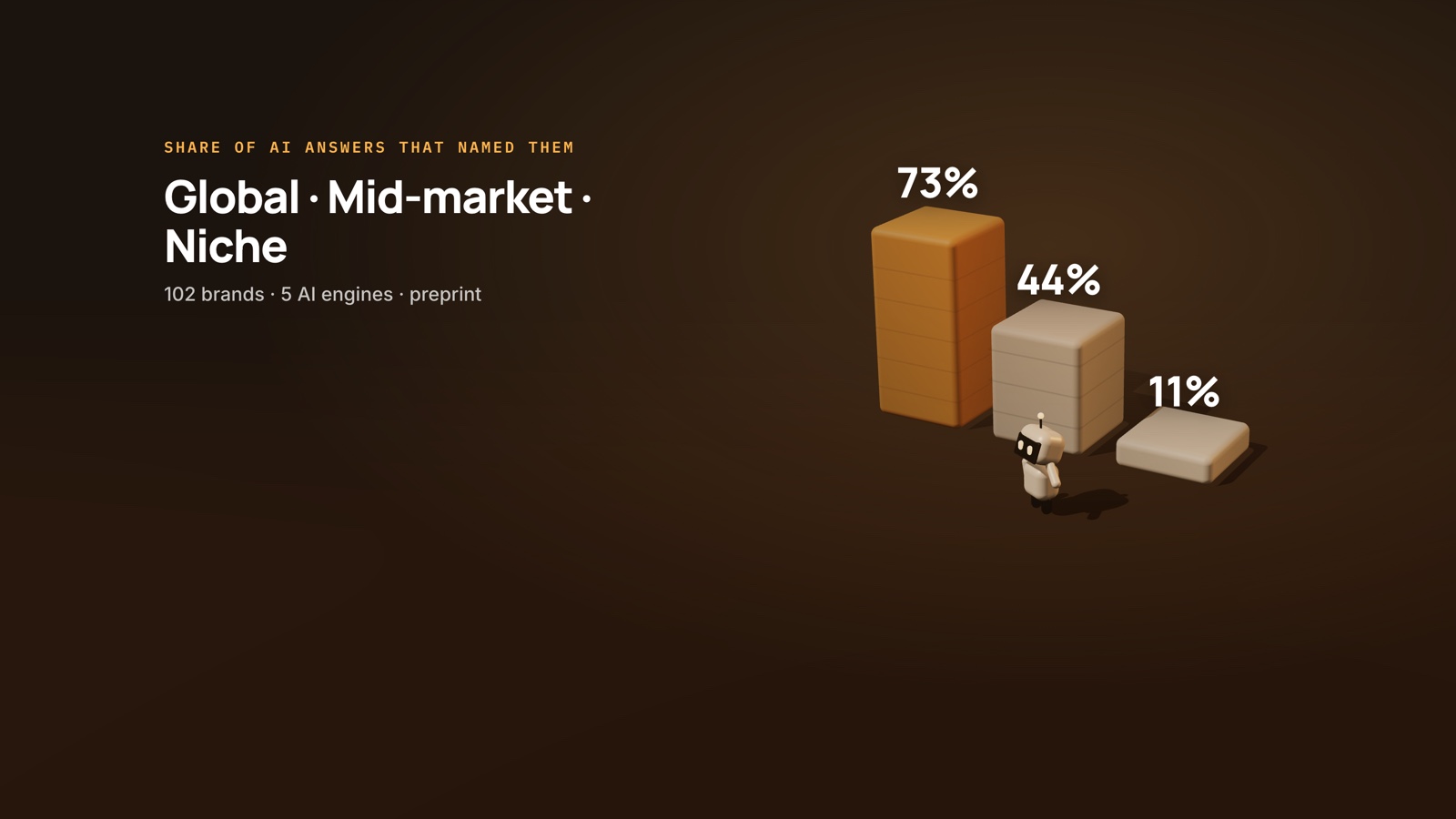
Yes, much less, in one large new study. It tracked 102 brands across five AI engines. Global brands appeared in about 73% of relevant answers, established mid-market brands in about 44%, and small or niche brands in just 11%. Each step down the ladder lost roughly 30 percentage points.
This is the gap topgeo.ai works on. topgeo.ai finds where AI recommends your competitors instead of you, then publishes AI-optimized pages on your own domain and builds the citations that get you recommended.
What did the study measure?
The paper is a preprint by Pratyush Kumar of Ranqo, an AI visibility vendor, posted on arXiv in June 2026. It analyzed 102,025 answers from ChatGPT, Gemini, Perplexity, Claude and Grok, collected between March and May 2026, for 102 brands.
Each brand was asked about through category questions that didn't name it, like "best tools for X". Visibility is the share of those answers that mentioned the brand, on its first tracking run.
How big is the gap?
| Brand tier | Brands | Share of answers that named them |
|---|---|---|
| Global household names | 11 | 72.9% |
| Established mid-market or regional | 36 | 43.6% |
| Small or niche | 55 | 11.4% |
The differences between all three tiers were statistically significant.
Where do AI engines get their information?
Mostly from other companies' websites. About 78% of citations went to corporate sites, but only 2.9% went to the tracked brand's own domain. The rest of that share went to pages from other companies in the same space.
Ranked "best-of" lists were the most cited content type, at about 21% of all citations. YouTube, business media, Reddit and Wikipedia followed.
Does AI describe brands the same way each time?
Not really. Whether a brand was mentioned stayed fairly stable from run to run. How it was framed, positive or negative, flipped about 6.7 times more often. So one good answer today doesn't mean the next one will sound the same.
What doesn't it prove?
Quite a lot, and the paper says so:
- One vendor, one author: the author co-founded Ranqo, and the data comes from Ranqo's own customers. It hasn't been peer reviewed or released.
- Observational: it shows a pattern, not what causes it, and it doesn't test whether any fix works.
- Hand-made tiers: brands were sorted by public signals like Wikipedia pages, press and funding, which overlap with what AI reads.
- A specific mix: the brands lean toward SaaS, fintech, retail and Indian direct-to-consumer, and the global tier has only 11 brands.
Where can a smaller brand start?
The paper doesn't show any action that moves a brand up a tier. Its own suggestion for small brands, building a wider presence on places like Wikipedia, mainstream press and YouTube, is a hypothesis, not a result. So start by measuring:
- Check where you stand: ask AI the questions your buyers ask and note whether you're named.
- Look at the sources: see which pages and lists the answers cite, and whether your competitors are on them.
- Watch the framing: check how you're described across several runs, not just once.
- Repeat it: the same checks every few weeks show whether anything is changing.
Source: Pratyush Kumar, "Generative Engine Optimization at Scale: Measuring Brand Visibility Across AI Search Engines", arXiv preprint, June 18, 2026.
Want to see how often AI names your brand?
Get a free AI visibility snapshot and see how your company shows up when buyers ask AI for a shortlist.