
Does Adding Schema Get Your Pages Cited by AI?
TopGeo Team
Author
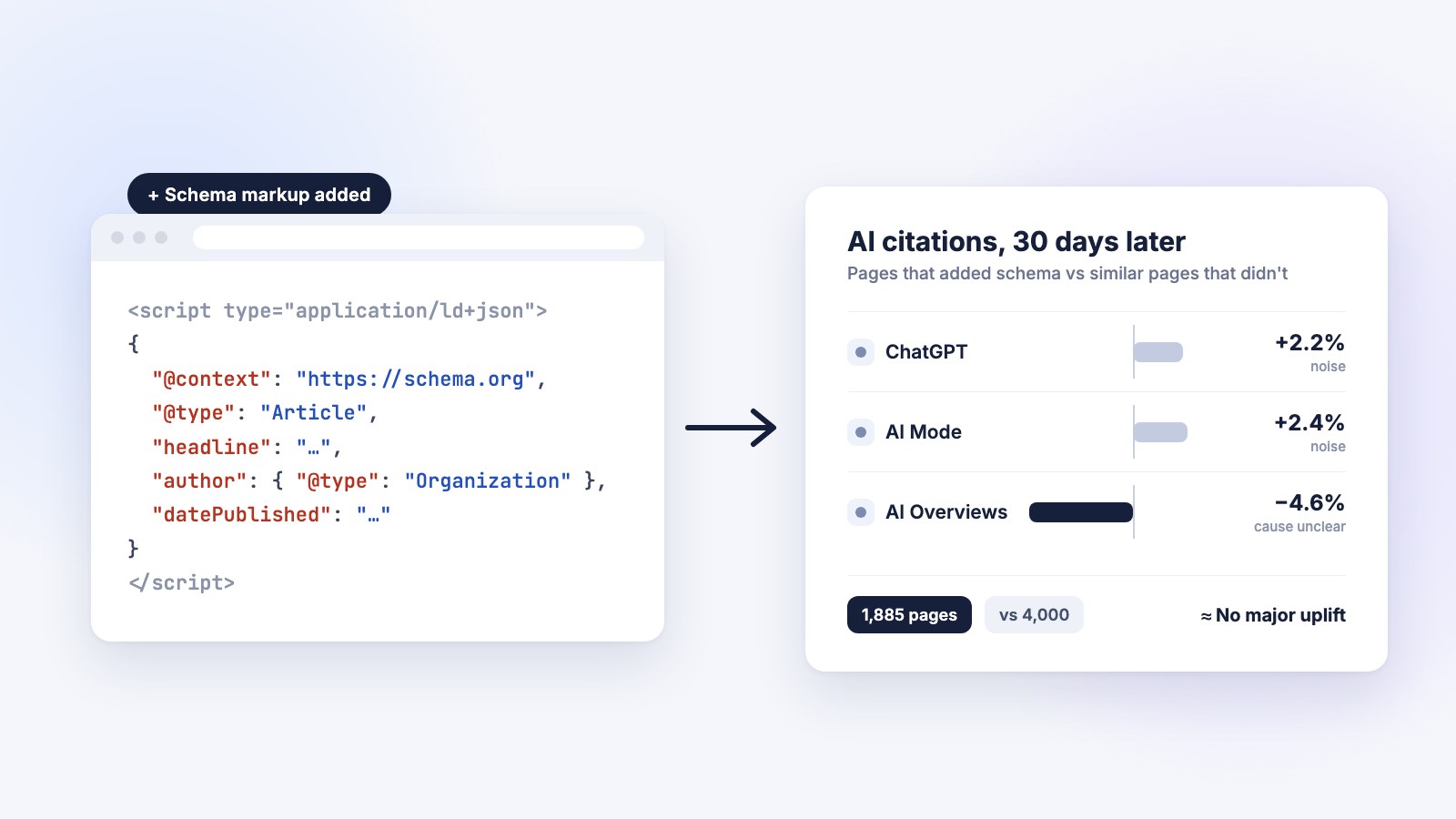
Not much, based on the biggest test so far. Ahrefs tracked 1,885 pages that added schema markup and compared them with 4,000 similar pages that didn't. Thirty days later, citations in ChatGPT and Google AI Mode had barely moved, and Google AI Overviews citations dipped slightly compared with the pages that didn't change.
What did the study find?
Ahrefs looked at pages that added JSON-LD schema between August 2025 and March 2026, then compared their AI citations in the 30 days before and after the change:
- Google AI Overviews: down 4.6% relative to the control group. A small, statistically significant decline, but Ahrefs says it can't tell whether schema caused it.
- Google AI Mode: up 2.4%, statistically indistinguishable from zero.
- ChatGPT: up 2.2%, also statistically indistinguishable from zero.
In Ahrefs' own words: "Adding schema produced no major uplift in citations on any platform."
Does that mean schema is useless?
No, and the study is careful about that. It only looked at pages that already had 100 or more Google AI Overview citations in February 2025, so the results shouldn't be applied to every page or every AI platform. For a page AI hasn't discovered yet, schema might still help. Pages also tend to change other things when they add schema, which makes its effect hard to isolate.
What the study does show is that schema isn't the shortcut it's often sold as. If your pages are already being cited, adding markup on its own is unlikely to move the numbers.
Why do GEO studies keep disagreeing?
Because AI visibility is noisy. Answers shift from week to week, and a small test can easily mistake a random swing for a real result. That's what the 4,000 untouched pages in the Ahrefs study are for: they show what would have happened anyway.
A lot of GEO advice is built on a before-and-after screenshot with nothing to compare it to. It's worth being skeptical of those.
How can you test it on your own site?
Ahrefs suggests a simple small-scale experiment. A handful of pages can be noisy, so treat it as a first check rather than a definitive answer. It works for almost any change, not just schema:
- Pick 5–10 pages that already get some AI citations and note their current numbers as a baseline. These get the change.
- Pick 5–10 similar pages with similar citation numbers. Leave these alone.
- Make the change only on the first group.
- Wait at least 30 days, then compare how citations moved in each group, engine by engine.
If the changed pages don't do better than the untouched ones, the change probably isn't doing much. If both groups move together, that's the platform changing, not your edit.
So what should you focus on?
Keep your schema. It's cheap and helps machines understand what a page is about. Just don't expect it to win citations by itself. More of the effort should go into what the page actually says: clear answers to real buyer questions, facts that are easy to check, and being mentioned on other trusted sites.
Source: Louise Linehan, "We Tracked 1,885 Pages Adding Schema. AI Citations Barely Moved.", Ahrefs, May 11, 2026.
Want to know what's actually moving your AI visibility?
Get a free AI visibility snapshot and see how your company shows up when buyers ask AI to shortlist vendors.