

Does ChatGPT Go Straight to the Source Website? What a 30,000-Prompt Study Shows
topgeo.ai Team
Author
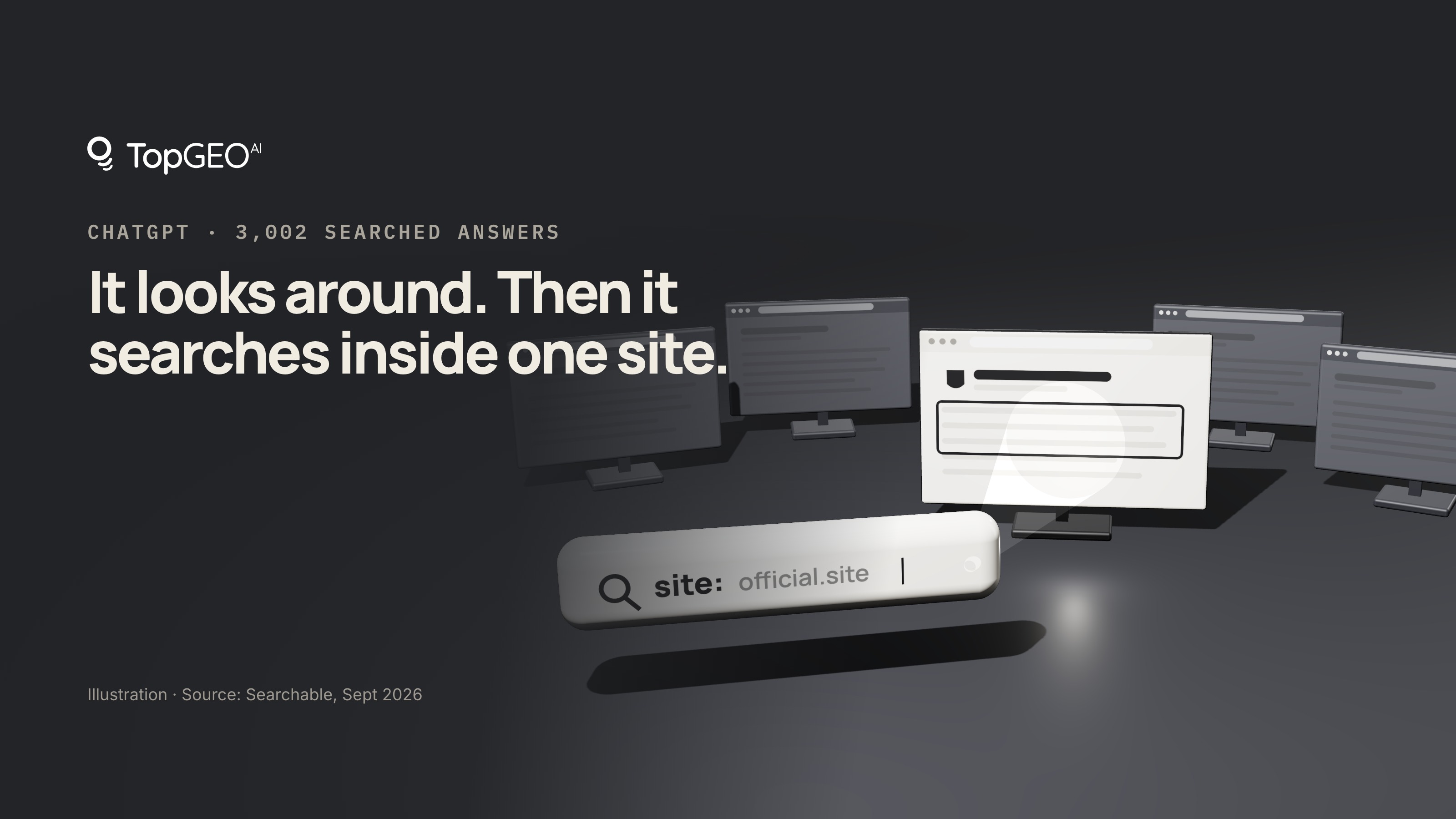
Often, once it has had a first look around. In Searchable's study of ChatGPT answers to UK local-news questions, 11.8% of ChatGPT's first-round searches were limited to a single website. In the second round, 70.2% were. And when it searched inside a website, it cited at least one of those websites 76% of the time.
What topgeo.ai does. topgeo.ai publishes AI-optimized pages on your own domain and monitors your brand's mentions, citations and rankings across the AI platforms your buyers use. To see whether AI names you today, start with a free AI visibility snapshot.
What did Searchable test?
Searchable, an AI search visibility company, asked 20 questions about local news and local services for each of 100 UK towns and cities, three times each, to five AI assistants: ChatGPT, Perplexity, Google Gemini, Google AI Mode and Google AI Overviews. That made 30,000 prompts, run on 9 and 10 September 2026 with a UK location set and no signed-in account. The answers carried 244,725 citations from just over 10,000 websites.
For ChatGPT, the team also recorded the web searches it ran before answering. That search data came back for 3,002 of ChatGPT's 6,000 answers, covering 9,700 searches, and every search figure below comes from those. Press Gazette covered the study on October 22.
How does ChatGPT search before it answers?
It searched the web for 5,863 of its 6,000 answers. It rewrites your question into shorter searches of its own, 7.8 words on average against 11 in the question, and adds the year to 94.5% of them.
One question became anything from 1 to 35 searches, 3.2 on average. ChatGPT sends them in rounds: a batch at once, then another after the first results come back. The first round is broad: 2,993 of the 3,002 answers began without naming any website. By the second round, that changes:
- 11.8% of first-round searches used site: to search inside one website
- 70.2% of second-round searches did
In other words, ChatGPT looks around first, then goes back to search inside the websites it has found, such as the council's own site.
Which pages end up cited?
One page in four that the searches return ends up cited. Most answers got back pages from 5 to 21 websites and cited 2 to 6 of them.
Searching inside a website made a difference. In the 981 answers where ChatGPT used site:, it cited at least one of the websites it had searched inside 76% of the time.
Searchable's Doncaster example shows the pattern. Four searches returned 25 pages from 8 websites, and six of the answer's citations went to the council's own site, doncaster.gov.uk. The Guardian, The Times and six Wikipedia pages came back in the same searches, and none of them was cited.
What does this mean for a B2B website?
Local news isn't B2B buying, so treat this as an analogy, not proof. But the shape is worth noticing. ChatGPT found the site that owned the answer, searched inside it and cited it, while bigger names in the same results went unused.
For a B2B company, the equivalent question is whether your own site is where the answer to your buyers' questions actually lives: your specs, prices, certifications and use cases, written plainly enough to be cited.
There's also a technical floor. A site: search can only return what ChatGPT's search is allowed to reach. OpenAI says sites that are opted out of its OAI-SearchBot crawler "will not be shown in ChatGPT search answers".
What doesn't the study show?
- Not B2B: every question was about UK local news and local services.
- ChatGPT only, and half of it: the search figures cover ChatGPT alone, and only the 3,002 answers with search data.
- Two days: the prompts ran on 9 and 10 September 2026, from a UK location, logged out.
- No cause: it shows how ChatGPT searched, not why it chose one website over another.
- Vendor data: Searchable sells AI search visibility services. Press Gazette's write-up also quotes figures on official versus news sources that aren't on Searchable's published page, so we've left them out.
What should you do with this?
- Ask ChatGPT your buyers' questions: note which websites it cites, and whether yours is one of them.
- Check your robots.txt: make sure OAI-SearchBot isn't blocked, or ChatGPT search won't show your pages in its answers.
- Answer your own questions on your own site: clear pages on what you make, what it costs and who it's for are worth investigating as the pages ChatGPT can search inside.
- Don't rely on bigger sites to speak for you: in the Doncaster example, well-known sites were returned and not cited.
Source: Connor Lahey and JP Garbaccio, Searchable, "How does ChatGPT search for local news?", updated September 21, 2026.
Does AI name your brand?
Get a free AI visibility snapshot: two of your buyer questions, asked word-for-word on ChatGPT and Google AI Overview, with your AI-visibility score and who AI names instead.