
Does ChatGPT Name Your Brand When It Cites Pages About You? What Graphite's Data Shows
topgeo.ai Team
Author
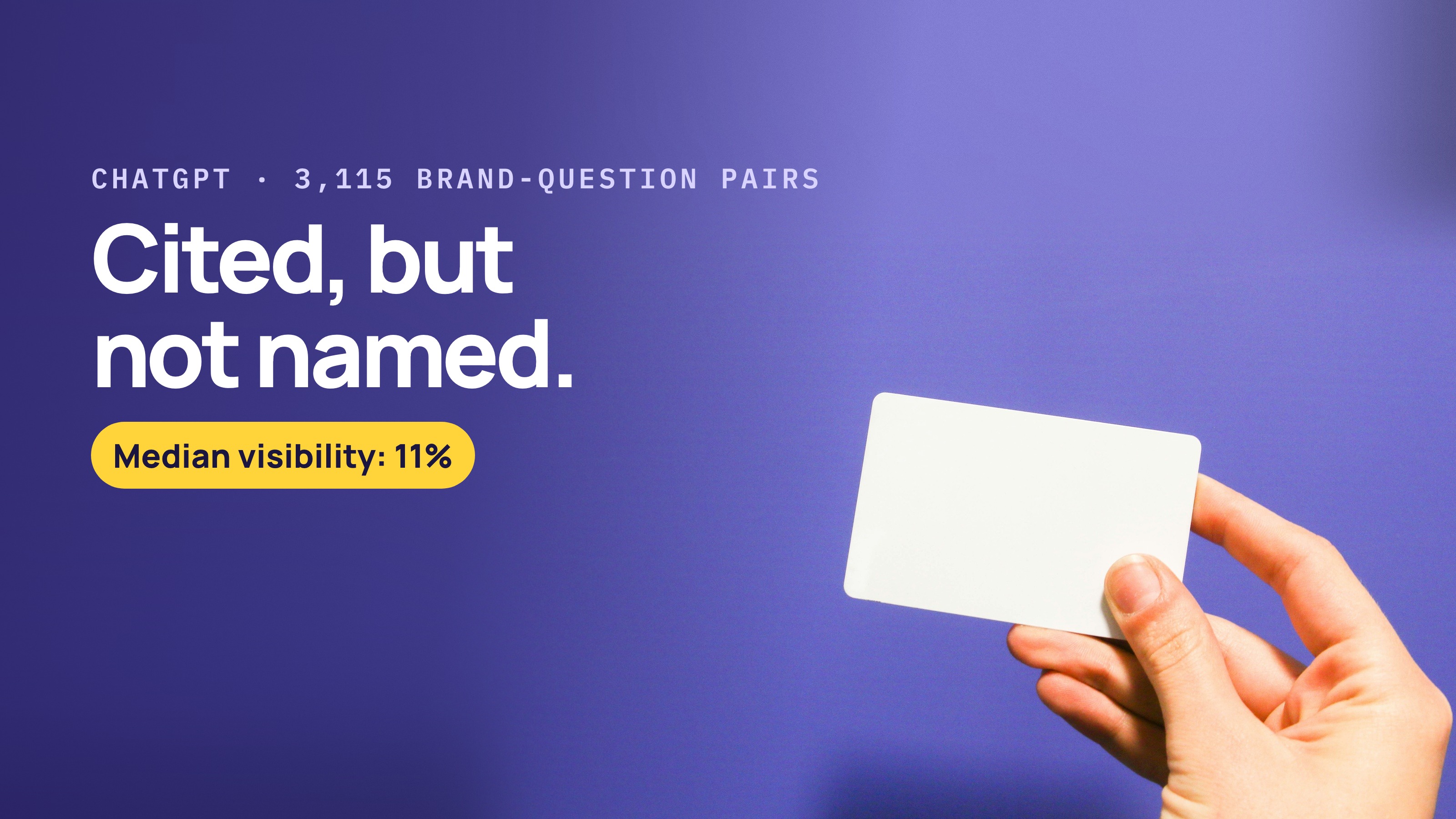
Often not, if it didn't already know you. In Graphite's study of 3,115 brand-and-question pairs on logged-out ChatGPT, brands that ChatGPT rarely named without search reached a median of only 11% visibility with search. That held even when 15% or more of the pages it cited talked about them in detail.
What topgeo.ai does. topgeo.ai monitors your brand's mentions, citations and rankings across the AI platforms your buyers use, and publishes AI-optimized pages on your own domain. To see whether AI names you today, start with a free AI visibility snapshot.
What did Graphite test?
Graphite, a growth agency that sells AEO services, published the analysis on October 16, 2026. The authors are Gregory Druck, Ethan Smith and Bevin Benson. Search Engine Journal covered it on October 26.
The team asked logged-out ChatGPT 57 questions in August 2026, with and without search, and scored 3,115 brand-and-question pairs. Visibility here means the share of answers that mention a brand or product. For the answers with search, they also checked how many of the cited pages mentioned each brand in a substantial way.
They then repeated the check twice: once with 100 prompts through the API, where search was switched on and off explicitly, and once with 200 prompts tracked in their own tool over a different three-week period. Both showed the same pattern.
What did they find?
What ChatGPT already knows about you seems to travel with it into search.
Take brands that ChatGPT named in under a quarter of its no-search answers. Even when they were mentioned substantially on 15% or more of the pages it cited, their median visibility with search was just 11%. In other words, being on the cited pages didn't mean being in the answer.
Graphite's summary is that "parametric knowledge visibility predicts search visibility at every level of cited-page mention rate." Parametric knowledge is what a model learned in training, before it searches anything. Visibility with and without search also rose together.
There's a second detail worth knowing. 51% of the cited pages substantially mentioned zero or one brand, and 25% mentioned five or more.
Why would ChatGPT cite you and still not name you?
The study can't say for sure, but the background searches give a hint. Graphite looked at about 957,000 fan-out queries, the searches ChatGPT runs behind the scenes, from 22,953 prompts that named no brand at all:
- 59.6% of those background searches contained a brand name
- 22.7% used a site: operator to search one website
So ChatGPT often brings brand names into its own searches, even when the user didn't type one. A smaller, one-account test written up in Search Engine Journal in August pointed the same way: in 21 of 27 conversations, ChatGPT's first search included brand names the user never typed.
What doesn't the study show?
- Correlation, not cause: visibility with and without search moved together, which doesn't prove one drives the other.
- No control for fame: the analysis didn't adjust for how well known each brand already is.
- Method gaps: per Search Engine Journal, the write-up doesn't explain how no-search answers were separated in the main dataset. Only the 100-prompt API check switched search off explicitly.
- No proof of a fix: the data doesn't show that getting mentioned on more cited pages would raise how often ChatGPT names you.
- Who's selling: Graphite promotes "parametric knowledge optimization", its own service for working on what models learn in training.
What should you do with this?
- Track mentions and citations separately: for your main buyer questions, log whether the answer names you, cites one of your pages, both, or neither. A "you were cited" report alone can hide the gap.
- Check with search off, too: Graphite suggests looking at what ChatGPT says without search after each new model, using at least 50 answers per prompt.
- Find out who AI names instead: if ChatGPT often searches by brand name, it helps to know which names it starts from in your category.
- Be named on the pages that cover your category: with half of cited pages naming at most one brand, being discussed in substance on those pages is worth investigating, even though the study doesn't prove it moves the answer.
Source: Gregory Druck, Ethan Smith and Bevin Benson, Graphite, "Parametric Knowledge Optimization", October 16, 2026.
Does AI name your brand?
Get a free AI visibility snapshot: two of your buyer questions, asked word-for-word on ChatGPT and Google AI Overview, with your AI-visibility score and who AI names instead.