
How Do You Find Pages That Name Your Competitors but Not You?
topgeo.ai Team
Author
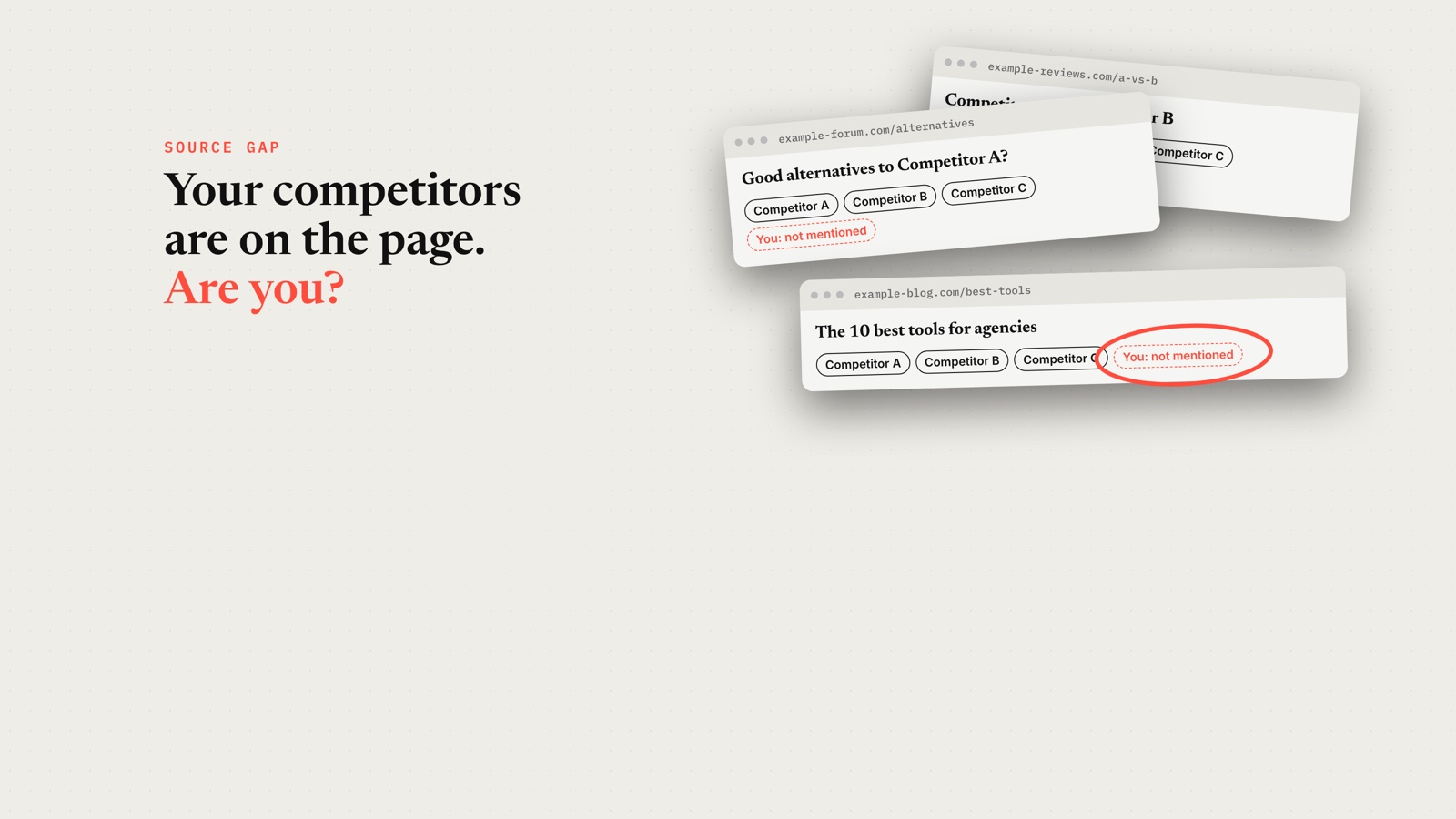
Ask AI the questions your buyers ask, collect the pages it cites, and list the ones that name your competitors but not you. That list is your source gap. These pages are worth investigating because they already appear in answers to questions relevant to your category.
This is what topgeo.ai does. topgeo.ai shows you where AI recommends your competitors instead of you, builds the citations that get you recommended, and publishes AI-optimized pages on your own domain, so your brand makes the shortlist when buyers ask. It's done for you, with no CMS migration and no dev work on your side. And when a buyer clicks through from an AI answer, the enquiry lands in your inbox, tagged with the AI engine that sent it.
Here's how to start finding your source gap yourself.
Why do these pages matter?
AI answers lean heavily on what the rest of the web says about a brand. Ahrefs studied 75,000 brands and how often Google's AI Overviews mention them. The factor most closely linked to being mentioned was how often a brand is talked about across the web (a correlation of 0.664). Backlinks were far weaker, at 0.218.
The gap at the top is steep. Brands in the top quarter for web mentions averaged 169 AI Overview mentions. The next quarter averaged 14.
Two caveats from Ahrefs itself: this is correlation, not proof of cause, and it covers Google AI Overviews only. But the message is consistent. If the sources appearing in answers to your buyers' questions consistently mention your competitors but not your brand, that's a visibility gap worth investigating.
What is a source gap?
It's the set of pages AI tools cite when they answer questions in your category, where your competitors are named and you aren't. Usually they're one of a few types:
- "Best tools for X" lists and roundups
- Comparison pages ("A vs B")
- Alternatives pages ("Alternatives to A")
- Review and directory sites
- Forum and community threads
How do you find yours?
- Write 20 to 30 questions your buyers actually ask, such as "best X for Y", "A vs B" and "alternatives to A".
- Ask them in ChatGPT, Perplexity and Google's AI results, with web search on, and save every page they cite.
- Open each page and note which brands it names, and whether yours is one of them.
- Keep the pages that name at least two competitors but not you. That's your source gap list.
- Sort it by how often each page gets cited. The pages that keep coming up go first.
How do you close the gap?
It depends on the type of page:
- Lists, roundups and comparison pages: contact the author with something genuinely useful, like a clear product description, pricing and real customer results, and ask to be considered at the next update.
- Review and directory sites: claim and complete your profile, and ask real customers for reviews.
- Forum threads: join the conversation honestly where you can help. Don't spam.
- Your own site: make it easy for others to describe you. One clear page that says what you do, who it's for and how you compare.
How often should you check?
AI tools change which sources they cite, sometimes after a single model update. A list that matters today may be ignored next quarter. Re-run the same questions every month or two and update your list.
Source: Louise Linehan, "An Analysis of AI Overview Brand Visibility Factors (75K Brands Studied)", Ahrefs, May 26, 2025.
Want to see which competitors AI names instead of you?
Get a free AI visibility snapshot and see where your company shows up when buyers ask AI for a shortlist, and where it doesn't.