
How Long Does an AI Citation Last? What 9,886 Tracked Answers Suggest
topgeo.ai Team
Author
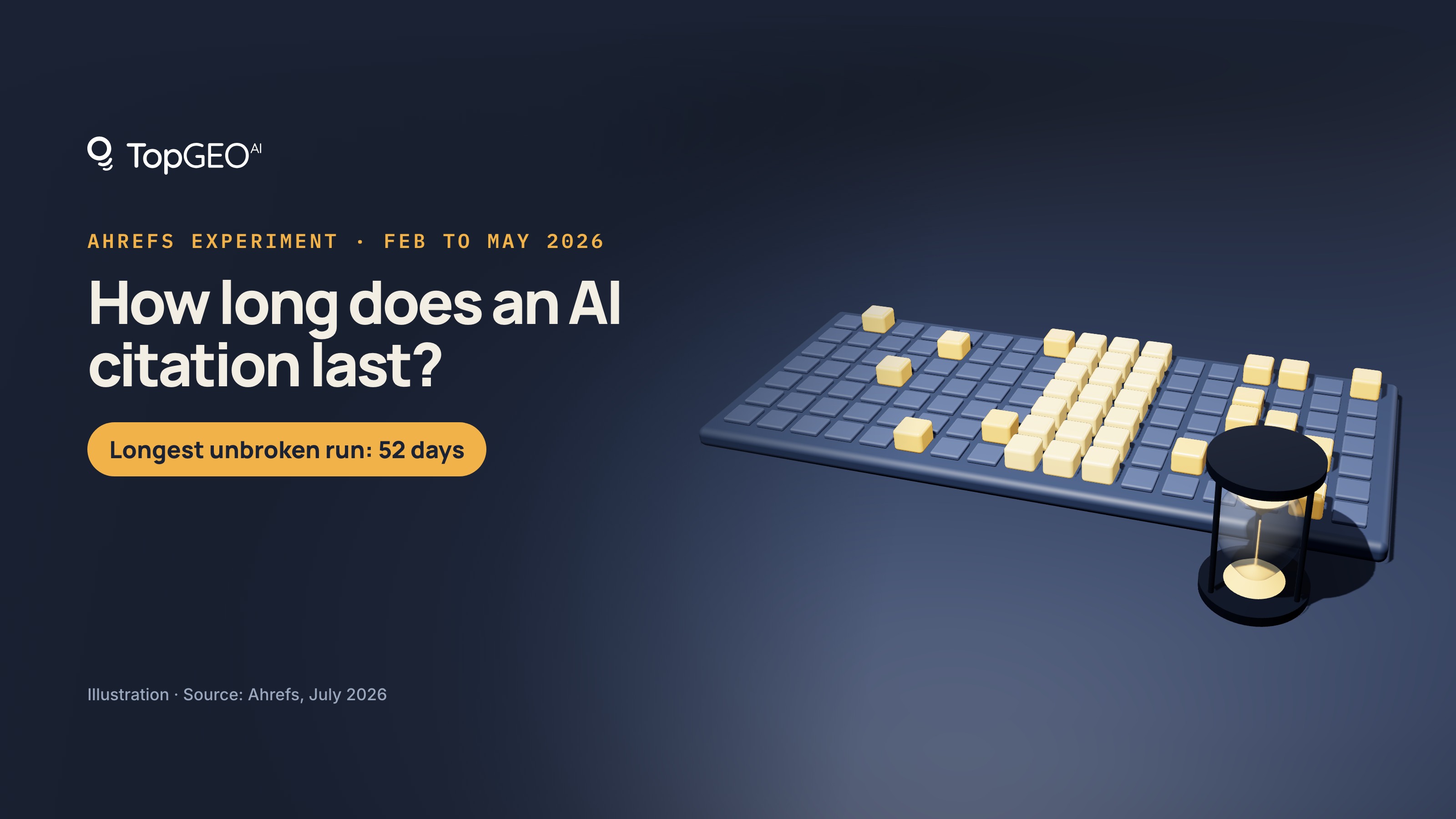
Often not for long. In a small Ahrefs experiment that tracked 9,886 AI answers, about one citation in four showed up once and never came back. Even pages that kept getting cited were cited on only about one in three days between their first and last appearance. The longest unbroken run Ahrefs saw was 52 days.
What topgeo.ai does. topgeo.ai monitors your brand's mentions, citations and rankings across the AI platforms your buyers use, and publishes AI-optimized pages on your own domain. As our site puts it, there is no universal citation timeline, so we start from a dated baseline and report the changes we observe. To see where you stand today, get a free AI visibility snapshot.
What did Ahrefs test?
In July 2026, Mateusz Makosiewicz at Ahrefs published a small experiment. Ahrefs staff published 34 self-promotional pages (listicles, reviews and opinion pieces) about two of their own products: the Brand Radar tool and the Ahrefs Evolve conference. The pages went up on five domains: ahrefs.com, bloggerjet.com, blog.timsoulo.com, medium.com and detailed.com.
They then tracked answers from ChatGPT, Gemini, Perplexity and Copilot between February 7 and May 31, 2026, using Ahrefs' own Brand Radar tool. That came to 9,886 answers over about four months.
Ahrefs separates two ways a page can show up. A cited page is attached to the answer as a clickable source. A found page was pulled in behind the scenes but not credited. The figures below are about cited pages.
How long did the citations last?
Not as long as most of us would assume. Ahrefs' own summary is that citations "were often temporary":
- About 1 in 4: in roughly a quarter of cases, a page was cited once for a specific query on a specific assistant, then never appeared again.
- About 1 in 3 days: between a page's first and last citation, it was cited on only about one in three eligible days.
- 52 days: the longest unbroken run for any single combination.
Pages also flickered. A page could be cited in March, disappear for weeks, then come back, even though nobody had changed it.
Did a strong domain help?
Not enough to stop the flicker. Pages on ahrefs.com were cited for longer periods overall, and they still appeared and disappeared often.
The few citations that did last were nearly all on Copilot, and in narrow, on-brand queries about conferences and "alternatives". That fits another result from the same experiment: Ahrefs Evolve appeared in 66.4% of responses to "best SEO conferences 2026", but in only 15.8% of responses to the broader "best marketing conferences 2026".
Ahrefs also points to a separate study of more than 43,000 keywords in Google's AI Overviews, where only about 54% of cited URLs carried over between consecutive checks. Nearly half the sources were new each time.
What does this mean for a B2B brand?
A single check is a snapshot, not a result. If you ask ChatGPT a buyer question today and your page is cited, that tells you about today. Ahrefs' data suggests the same question next week may cite someone else, and your page may come back the week after.
So "we got cited" is the wrong finish line. The more useful questions are how often you're cited for a query, on which engines, and whether that rate is moving. That takes repeated checks, with the date recorded each time.
It also suggests where to aim. The lasting citations came from narrow queries where the brand was an obvious fit, not broad categories.
What doesn't the study show?
- Small scale, by the seller: Ahrefs staff ran it on their own pages and brands, and measured it with a tool Ahrefs sells. Ahrefs itself calls it a small-scale experiment.
- About four months: the data runs from February 7 to May 31, 2026, and was published on July 6, 2026. Engines may behave differently now.
- Self-promotional pages only: every tracked page promoted an Ahrefs product. Other kinds of pages may last longer or shorter.
- Rounded figures: "about a quarter" and "about one in three" are Ahrefs' approximations, and the article doesn't break lifespan down by engine beyond saying the lasting runs were nearly all on Copilot.
- No cause: it shows that citations come and go, not why.
What should you do with this?
- Track the same questions over time: ask your buyers' questions on a schedule and log the date, the engine and which pages were cited.
- Measure a rate, not a moment: count how many checks cited you out of how many you ran, per engine.
- Start with narrow questions you clearly belong in: in Ahrefs' data, the citations that lasted came from narrow, on-brand queries.
- Keep your pages accurate and current: Ahrefs suggests regular updates may help, since AI systems often favor current information. Treat that as worth testing, not a guarantee.
Source: Mateusz Makosiewicz, Ahrefs, "Self-Promotional Content Works—Until It Backfires (AI SEO Experiment)", July 6, 2026.
Where does AI cite you today?
Get a free AI visibility snapshot: two of your buyer questions, asked word-for-word on ChatGPT and Google AI Overview, with your AI-visibility score and who AI names instead.