

What Do AI-Cited Pages Have in Common? What a 96,418-URL Study Shows
topgeo.ai Team
Author
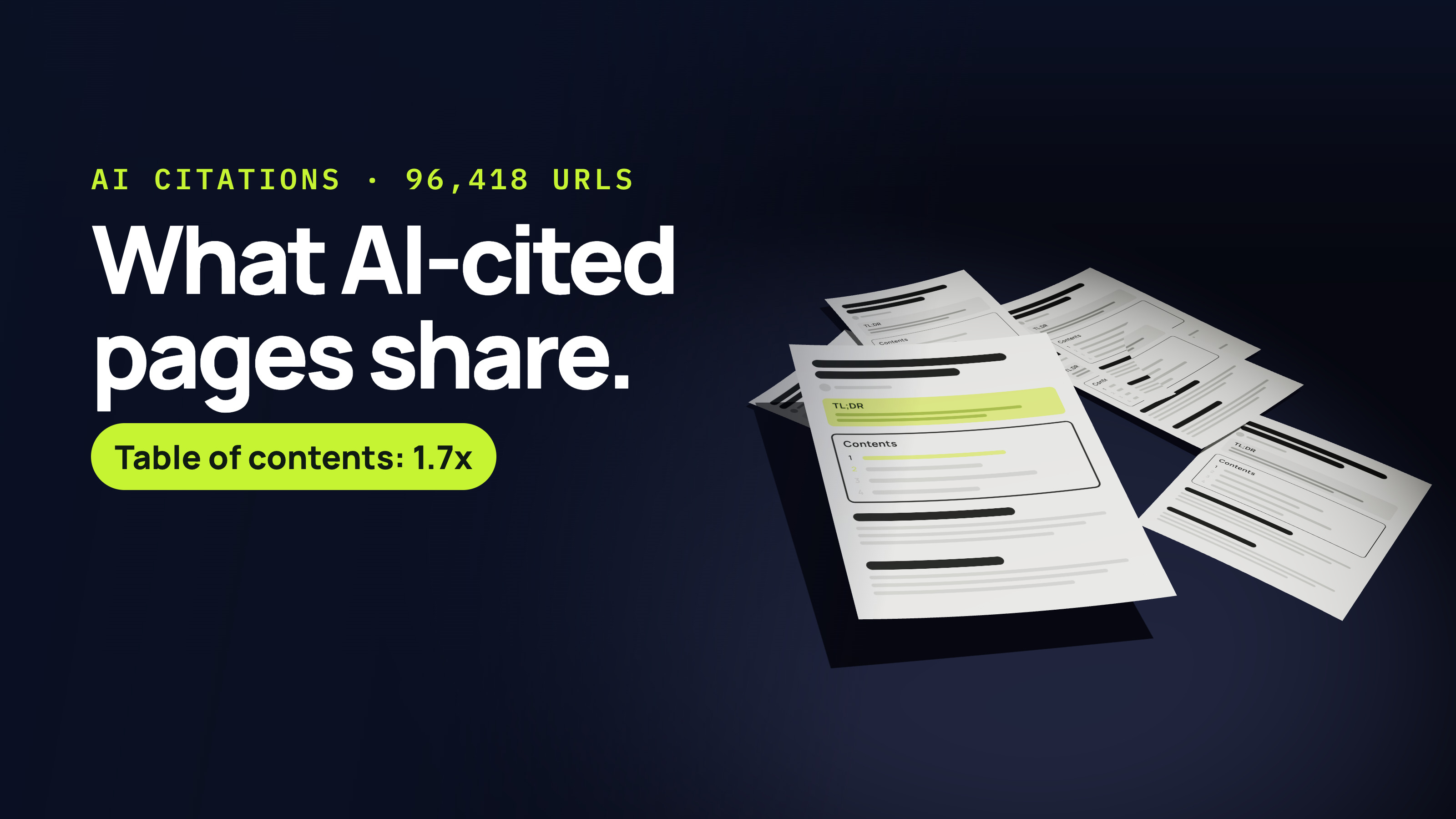
Mostly clear structure and fresh, well-maintained content. In a SISTRIX study of 96,418 URLs, pages with a table of contents were cited 1.7 times as often as similar pages on the same site without one. Pages with at least five H2 headings, or with Article schema, were cited 1.6 times as often. Having an llms.txt file showed no measurable advantage. It's a correlation, not proof that adding these features gets you cited.
This is the gap topgeo.ai works on. topgeo.ai publishes AI-optimized answer pages on your own domain, and scores every page on grounding, SEO, citability and conversion before it goes live. You can see where you stand with a free AI visibility snapshot.
What did SISTRIX study?
SISTRIX published the study on October 22, 2026, written by Johannes Beus and Julia Weissbach. They took 48,527 pages cited by ChatGPT, Google's AI Mode or AI Overviews in German-speaking markets (Germany, Austria and Switzerland) in the second quarter of 2026. Each cited page was paired with a page from the same website that wasn't cited, for 96,418 URLs from 17,380 domains, and each page was checked for 43 features.
Comparing pages on the same site matters. It means a strong brand alone can't explain the difference.
Which features went with more citations?
Each number shows how often pages with the feature were cited, compared with similar pages without it:
- Table of contents: 1.7 times
- At least five H2 headings: 1.6 times
- Article schema: 1.6 times
- FAQPage schema: 1.5 times
- A table with a header row: 1.5 times
- Author box with a photo: 1.4 times
- At least one question as an H2: 1.4 times
- Visible last-updated date: 1.3 times
- A TL;DR at the start: 1.3 times
The current year in the title scored highest, at 2.7 times, but SISTRIX calls it an early indication only. The authors read it as a sign of fresh or well-maintained content, not a title trick. Pages with many of these features at once were cited 2.1 times as often as barely optimized pages, yet only 10% of cited pages had many of them.
Which features didn't help?
- llms.txt: 11.7% of cited pages came from domains with an llms.txt file, while 14.0% of all domains in the data had one. No measurable advantage.
- Some schema types: Breadcrumb, HowTo and QAPage schema showed no effect. Product schema went with fewer citations (0.8 times), and Recipe schema with far fewer (0.1 times).
- An old year in the title: only an older year in the title went with fewer citations (0.7 times).
What doesn't the study prove?
The authors are clear about the limits:
- Correlation, not cause: it shows which features cited pages tend to have, not that adding them causes citations.
- One region, one quarter: it covers German-speaking markets in the second quarter of 2026.
- Three AI products: Perplexity, Claude and the Gemini app weren't included.
- Small samples mislead: at 833 URLs, FAQ schema looked 23% less common on cited pages. At 96,418 URLs, it was 19% more common. Their rule of thumb: "Don't trust a GEO study with fewer than 5,000 URLs."
What should you do with this?
SISTRIX's own advice is to build features that help readers, not to tick boxes. A few practical steps:
- Structure long pages: add a table of contents and clear H2 headings, including questions your buyers ask.
- Show who and when: an author box and a visible last-updated date, and keep the content current.
- Use tables where data fits: a table with a header row beats a wall of numbers.
- Skip the shortcuts: don't pad word count, don't add FAQ blocks or summaries where they don't fit, and don't count on llms.txt.
Source: Johannes Beus and Julia Weissbach, SISTRIX, "Citation Worthiness: Which GEO Tactics Hold Up Across 96,418 URLs", October 22, 2026.
Want to see what AI says about your brand?
Get a free AI visibility snapshot and see how your company shows up when buyers ask AI for a shortlist.